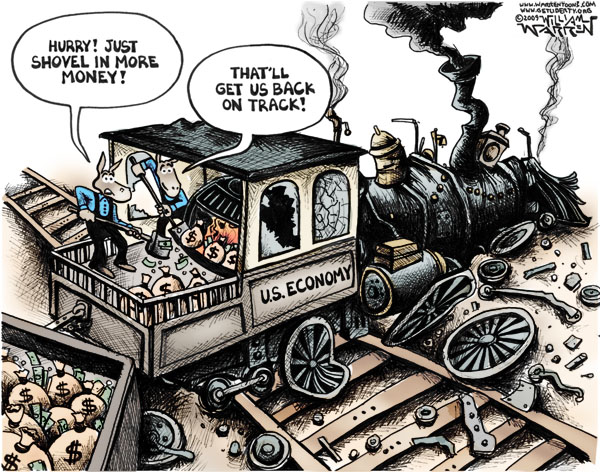
That’s how Americans for Limited Government (ALG) President Bill Wilson described the latest scam by government and financial institutions to boost “growth.” Having exhausted the market for crappy loans in housing and college students, now banks are turning their attention to the rapidly growing industry of subprime auto loans — that is, loans to borrowers with bad credit, yielding higher interest rates, and are more likely to default. |
Car loans you can’t afford the next subprime
Actual auto expenses or standard mileage rate? Which business deduction method will cut your taxes more?

Has all the attention given Google's driverless car got you thinking about your auto? If you're a business owner, it could be the perfect vehicle.
It has no steering wheel, accelerator or brake pedal to mess with. You use your smartphone or tablet app to summon the vehicle, set your route, get in and go. Then just sit back and enjoy as the Google machine takes you to your destination.
If it's to a business meeting, you can use the time you otherwise would be driving to polish your presentation. Or you can call your spouse to ask him or her to pick up dinner or the cleaning or the kids. Or you can just relax so you'll be in the best frame of mind for your important professional encounter.
More Pinoys Purchase a New Car with help from Financing

In the first quarter of this year, Bangko Sentral ng Pilipinas (BSP) reported that auto loans increased by 26% to P244.61 billion from P194.37 billion the previous year.
The demand for car loans in the Philippines will continue to increase as more Pinoy car buyers see financing as a better option when purchasing a new car, Carmudi said.
In its recent study, the company reported on the growth of car financing in the Philippines as well as other emerging markets. The white paper entitled “Car Financing in the Philippines” provides a look into the current and future state of car financing and how consumer attitudes toward credit have changed in recent years.
5 Ways To Pay Off Your Car Loan Sooner
Getting rid of debts like car loans sooner rather than later can be a solid investment in your future for a number of reasons. It not only improves your credit history, but means more money in your bank account, so if you’re lumbering away under the cloud of debt, here are five ways to ease the burden and help pay off your car loan sooner.

5 Financial Tips for Recent College Graduates

As a recent college graduate, I know how intimidating personal finance can be. Fortunately, there is a wealth of (free) knowledge online to serve as a starting point for a sound financial education. Here are a few tips I've gathered from friends, family, experience, and online resources to help college graduates (and non-graduates) from any background.
1. Maximize savings on large, recurring payments
There are dozens of sites and apps to help you navigate and keep track of spending – personally, I like Mint.com. Take a good look at your credit and debit card spending and calculate where your money is going as a percentage of your total spending. The biggest portions are your heavy-hitters: rent, food, insurance, loan payments, transportation, etc. Rent is commonly the single most expensive bill you will have to pay on a monthly basis. Keep in mind that it may be unwise to pay more than about one-third of post-tax income on rent. First, be open to trade-offs. The apartment that you're touring may not be in your dream neighborhood, but let's say it's $200 cheaper per month and transportation is only $40 more per month. That's nearly $2,000 in net savings per year. Second, sign a longer-term lease. A year-long lease is generally given at a lower rate per month than a shorter-term lease. If you were able to live in a college dorm room for a year, you can sign for an apartment for a year. Research your own heavy-hitters and look to reduce them where possible.
The Student Loan Scam

Full disclosure: I am currently paying federal student loans that I obtained while in college. I never finished college and it was never a huge amount (about $6000), nor do I expect any kind of reform to ever benefit me, but it would be unfair to say I’m a completely disinterested party.
That said, student loans are big business in the United States. The federal government makes over $40 billion in profits on student loans annually, to say nothing of what private firms make. There is currently more than $1.2 trillion in outstanding student loan debt. To put that in perspective, the total amount of all credit card debt in the US is about $900 billion. It’s not a small amount of money.
8 Ways to De-Corporatize Your Money

1. Ditch the Cards
All electronic transactions siphon money out of your community to some extent, so try the human approach and bank in person. Pay in cash or, second best, write a check. If you have to use plastic, choose debit. Your local merchants lose some of their profit any time you use a card, but they pay up to seven times more in fees when it’s a credit card. And studies show people spend 12 to 18 percent more when they use cards instead of cash.
2. Move Your Debt
Already broke up with your mega-bank? From credit card balances to car loans to mortgages, mega-banks make far more money off your debt than your savings. Refinance your debt with a credit union or local bank and let your fees support your community. Be wary of “affinity credit cards,” which donate a certain amount per purchase to good-hearted organizations but often are connected with a mega-bank.
5 Ways to Make Your Dollars Make Sense
Americans’ long-term savings in stocks, bonds, pension, life insurance, and mutual funds total about $30 trillion. But not even 1 percent of these savings touches local small businesses, the source of half the economy’s jobs and output. Is it possible to beat Wall Street’s 5 percent long-term performance by investing in your community? The answer is a resounding yes!

Co-op members who lent to the Weaver Street Market in North Carolina and to the Seward Co-op in Minneapolis earned well over 5 percent per year. Many outside investors who bought preferred shares of the Coulee Region Organic Producers Pool, a co-op of organic farmers, are still receiving an annual dividend of 6 percent. Equal Exchange has paid a dividend to its preferred shareholders averaging above 5 percent for 22 years. Investors who participate in New Markets Tax Credits automatically get a tax credit equal to 5 percent of their capital for each of the first three years and 6 percent for the next four—even if the investment generates no real return whatsoever. Burt Chojnowski’s returns have been good enough to convince outside investors to put more than $300 million into his local companies and projects over 25 years in Fairfield, Iowa. Most of LION’s deals in Port Townsend, Washington, are paying between 5 and 8 percent returns per year. Microlenders on Prosper.com are averaging an annual return of 10.4 percent. Jeff Haugland has paid the local shareholders of Community Grocers in Mount Ayr, Iowa, an annual dividend of 5.25 percent.
Buying a New Car fo Back to School? Some Tips to Consider!
Labor Day is approaching quickly, coeds are off to school, and summer car buying season is in full swing - with current auto loan interest rates holding steady in the low 4%,(1) consumers are regaining confidence in the economy,(2) and venturing to dealerships looking to take advantage of late 2013 vehicle model deals.

The decision to purchase a vehicle involves a number of budget considerations, and CarFinance.com has created key tips to empower consumers with detailed budget know-how throughout their vehicle selection process- they are especially important for college students, who may be living on their own for the first time!.
Items to calculate before signing on the dotted – or electronic – line:
Are Online Cash Stores More Expensive Than Offline Stores?
Online cash stores offer a variety of rates. More often than not, they are less expensive than offline stores. Of course there are companies that offer extremely high rates, but you can avoid them if you shop around. In fact, that is one of the biggest advantages to online stores – you can compare rates in minutes to find the lowest finance fees.

Fees To Look For
Most cash stores charge a flat fee rather than a percentage of your payday loan. Some online cash stores also charge an application fee. By shopping around you can find lenders who don’t charge this. And some of these lenders will waive the fee for first time borrowers.
When you are comparing fees, you should look at the APR or annual percentage rate. This number is what the loan would cost if you carried it for an entire year. While most customers make their payment in less than a month, the APR allows you to make quick comparisons.
Watch Out For High Rates
Don’t sign up for the first cash advance offer you get. Shop for rates first. You can do this by calling around, but an easier way is to look up rates on line. You can find the APR or fees either under ‘Fees’ or the ‘FAQ’ section. If you can’t find numbers to compare, email the company.
You also want to pay attention to how long the loan fees are for and make sure you compare the same numbers. For instance, if you need a cash advance for 14 days, look at the finance fees for the 14 day period with each lender.
Understand Payment Plans
Another way lenders can take advantage of your situation is by delaying your payments. Lenders who only deduct the minimum payment rather than the total amount will charge you more in finance fees. Initially these lenders may have low rates, but by adding more time to your loan, you rack up finance charges.
If you choose to go with one of these lenders, make sure you set up a full payment on your payday. That way you will pay the minimum finance fees, keeping money in your pocket.
source:finance-slot.blogspot.com
Subscribe to:
Posts (Atom)